
May 1st, 1997, marked the beginning of a new chapter for me. By May 17th, on my 30th birthday, Peter (ON6TT) sent me on my first real humanitarian mission: dismantling a radio communications center in Mwanza, Tanzania.
“Just head to the airport,” Peter said casually. “A plane is waiting for you.”
“How do I get back?” I asked.
Peter, with his characteristic cheek, replied, “Figure it out.”

Baptism by Fire
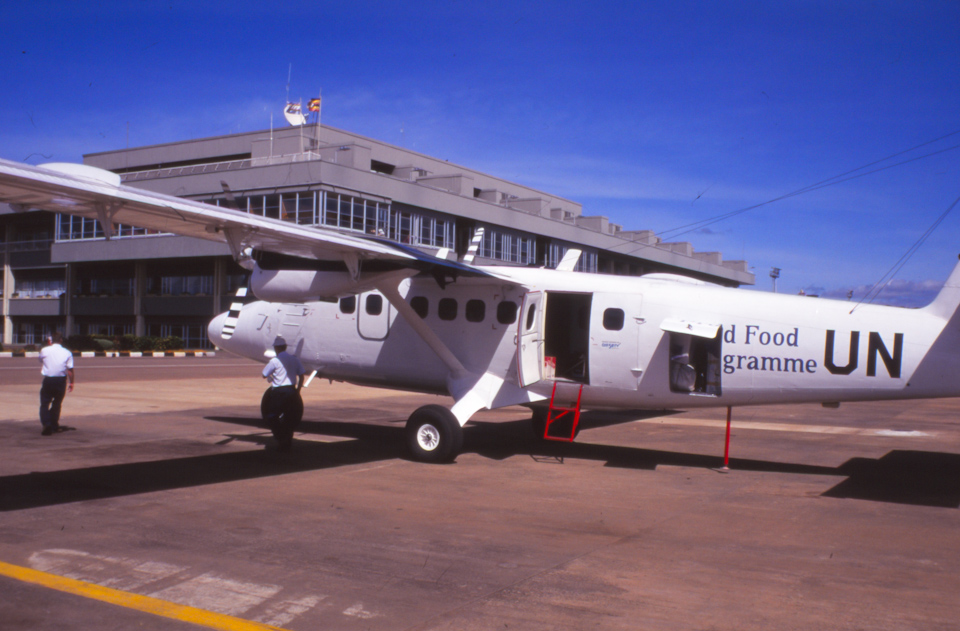
I boarded a special chartered Cessna Caravan as the sole passenger. Upon landing in Mwanza, the plane departed as swiftly as it had arrived, leaving me to meet a group of Norwegian Refugee Council volunteers packing up their office. I got to work disassembling and packing all the comms equipment, completing my part of the mission.
On the airstrip, I saw three massive Ilyushin cargo planes being loaded with food. “We’ll catch the next rotation back to Entebbe,” one of the Norwegians assured me.
A few hours later, the planes returned, and we climbed aboard after the crew loaded more supplies. Then came the twist. The crew explained the flight plan:
- Fly to Kisangani, DRC, to offload food.
- Pick up 300 Rwandan refugees.
- Fly to Kigali to drop them off.
- Finally, return to Entebbe.
A Humbling Experience
When we landed in Kisangani, the sight of the refugees was overwhelming. I was told these were the “better-off” ones, yet to my eyes, they were skin and bones. The fact that they could walk onto the plane was apparently a good sign.
Despite carrying my camera, I couldn’t bring myself to take pictures. Documenting misery felt wrong.
The Ukrainian crew, meanwhile, was celebrating their final mission with whiskey. The Norwegians celebrated their national day, Syttende Mai. And there I was, somehow marking my 30th birthday, my first mission, and my initiation into the humanitarian world—all at once.
It was a whirlwind of emotions: the deep sadness of witnessing human suffering, the humility of being part of a meaningful cause, and the certainty that this was work worth doing.
Even now, 27 years later, I hold the same belief. However, I’ve become more critical of what constitutes genuine humanitarian aid versus political agendas disguised as support. That’s probably a book for another time. Let’s just say—never trust the news entirely.
Ham Radio in Uganda
Back in Uganda, I quickly set up a ham station and was assigned the call sign 5X1Z. Peter operated as 5X1T, and together we participated in contests during those first few years. We also made trips to Dayton Hamvention, Friedrichshafen, and, at one point, even Visalia.
Occasionally, we operated from DR Congo and Zambia during missions, but there were no full-scale operations during work assignments.
Breaking New Ground
In 1998, I spearheaded the installation of the organization’s first-ever global VSAT system—a 4.6-meter DAMA C-Band unit in Kampala. This was followed by two more 3.8-meter antennas: one in Tanzania and another at the organization’s headquarters in Rome. It was a technical milestone that laid the foundation for more advanced communication capabilities in the field.
The Double Trouble DX-Pedition
In 1999, I took a two-month break from work to organize the T31T/T31T and ZK3CW/ZK3DX Double Trouble DX-peditions. This was an ambitious endeavor—activating two separate locations with the same equipment.
The team included SM6CAS, his daughter SM6WYN, OH1RY, and my longtime hero SM0AGD, who had supported my early DX-pedition efforts. Joining us were G4EDG and LA7MFA, making it a larger group than I was used to.
With larger teams, particularly with members you’ve never traveled with before, the complexity increases. Add the challenge of setting up and breaking down gear twice, in two remote locations, and the task becomes even more daunting.
Lessons Learned and Goals Achieved
One thing I had already learned from both DX-peditions and my humanitarian work was that discomfort tends to breed cliques. However, our team managed to work through the complexities, delivering an outstanding operation.
With 70,000 QSOs and nearly 25% of them from Europe, we achieved our goals. It was a challenging but deeply satisfying experience, and reconnecting with old friends while meeting new ones made it all the more rewarding.
Back to Reality
After the DX-pedition, I returned to Uganda and dived straight into a particularly busy period at work. The contrast between the two worlds—one of passion-driven pileups and the other of high-pressure humanitarian logistics—was stark but exhilarating.
That year solidified my understanding of balance: between passion and profession, between teamwork and leadership, and between the thrill of the airwaves and the grounding reality of serving others.
The journey was just getting started.